Scaling Production AI Systems: Architectural Patterns for Multi-Agent Coordination
Explore deployment topologies, event-driven AI, and service mesh patterns for scaling production AI systems at codeintel.xyz
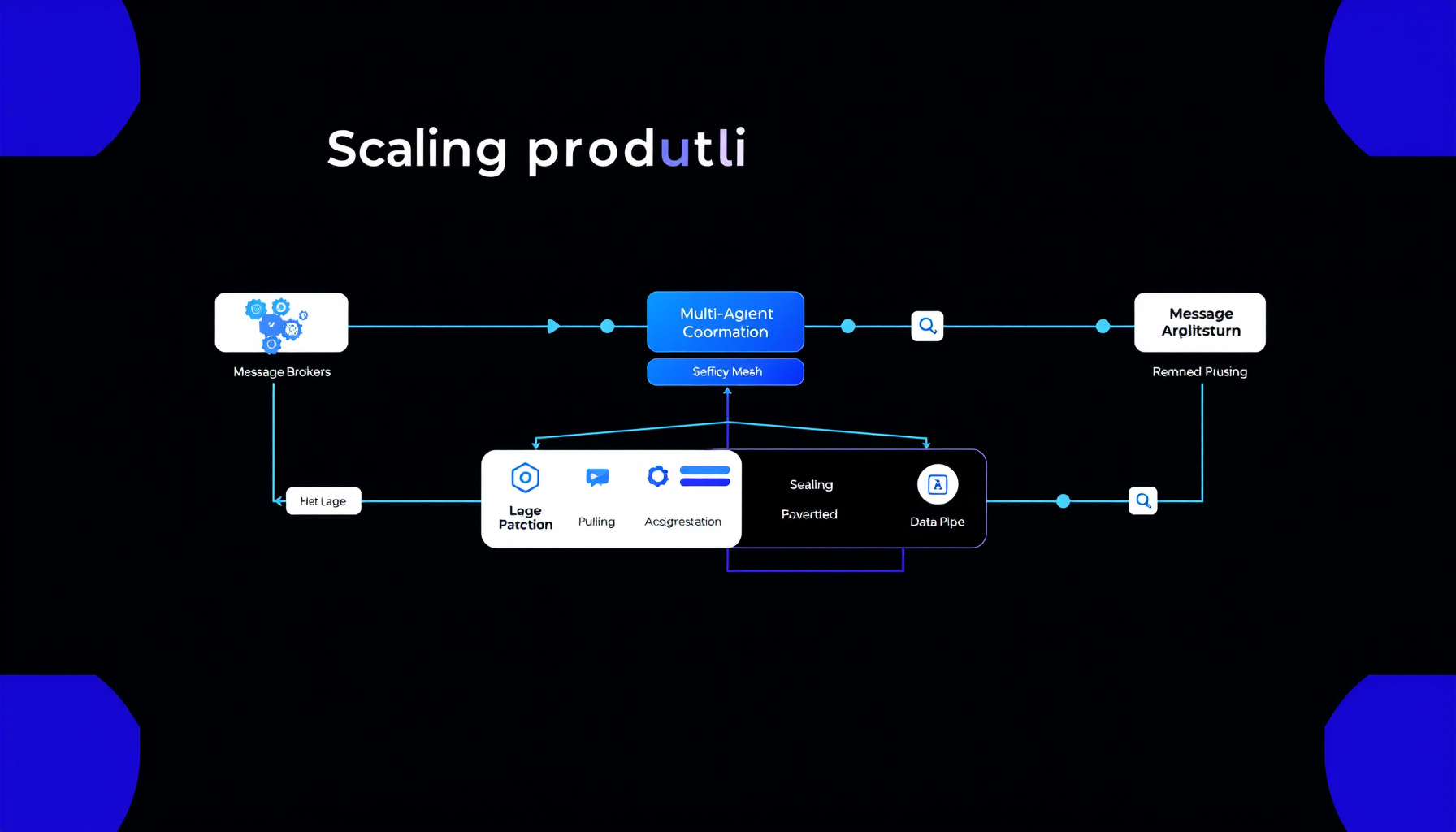
Hero
As production AI systems grow in complexity, scaling inference workloads and coordinating multi-agent workflows becomes critical. Traditional monolithic architectures struggle with latency, fault tolerance, and operational overhead. This post explores architectural patterns for scaling AI systems through event-driven topologies, streaming inference pipelines, and service mesh orchestration. We evaluate each pattern on real-world tradeoffs: throughput, latency, operational complexity, and team autonomy.
Technical Deep-Dive
Event-Driven AI Architectures
Event-driven architectures decouple components using message brokers, enabling horizontal scaling. For AI systems, this translates to independent scaling of model servers, pre-processing pipelines, and post-processing consumers — each can be scaled based on its own queue depth without coordinating with other stages.
from kafka import KafkaProducer
import json

producer = KafkaProducer(bootstrap_servers='kafka-cluster:9092')

def publish_inference_request(model_id: str, payload: dict):
    """Publish inference request to Kafka topic"""
    message = {
        "model": model_id,
        "data": payload,
        "timestamp": datetime.now().isoformat()
    }
    producer.send('inference-requests', json.dumps(message).encode('utf-8'))
Key components in production deployments include:
- Kafka for high-throughput event streaming [1]
- Debezium for change data capture [2]
- Consumer groups for parallel processing
Service Mesh for Agent Coordination
Service meshes provide observability and reliability for distributed AI agents:
# Istio virtual service for agent routing
apiVersion: networking.istio.io/v1alpha3
kind: VirtualService
metadata:
  name: agent-router
spec:
  hosts:
  - "agents.codeintel.xyz"
  http:
  - route:
    - destination:
        host: agent-service
        subset: v1
      weight: 80
    - destination:
        host: agent-service
        subset: v2
      weight: 20
Production implementations require:
- Circuit breaking for agent failures [3]
- Mutual TLS for secure inter-agent communication [4]
Tradeoffs & Alternatives
| Pattern | Scaling Advantage | Complexity | Fault Tolerance | Use Case |
|---|---|---|---|---|
| Event-Driven | Horizontal scaling | High | Excellent | High-throughput inference |
| Service Mesh | Observability | Moderate | Excellent | Multi-agent routing |
| Monolithic | Low initial complexity | Low | Poor | Prototyping |
| Microservices | Team autonomy | Very High | Good | Large engineering orgs |
Decision Framework
- Workload Characteristics:
- Low-latency requirements → Service Mesh
- High-throughput → Event-Driven
- Team Structure:
- Distributed teams → Microservices
- Centralized teams → Monolithic
- Operational Needs:
- Observability → Service Mesh
- Simplicity → Monolithic
References
[1] Apache Kafka Documentation [2] Debezium Change Data Capture [3] Istio Circuit Breaking [4] Service Mesh Security
📖 Related Reads
- NiteAgent — AI agent development, frameworks, and production patterns
- ToolBrain — tool reviews, LLM comparisons, and AI workflow guides
🏆 Arena Match This post was generated by a 5-model arena competition. Winner and scores will be added after judging.
📖 Related Reads
- NiteAgent — AI agent development, frameworks, and production patterns
- ToolBrain — tool reviews, LLM comparisons, and AI workflow guides
Cross-links automatically generated from CodeIntel Log.