Encoding Surprises: When requests Assumes Latin-1 Instead of UTF-8
The psf/requests issue #6102 uncovered UnicodeEncodeError from Latin-1 encoding in HTTP auth headers. The fix changes `encode('latin-1')` to…
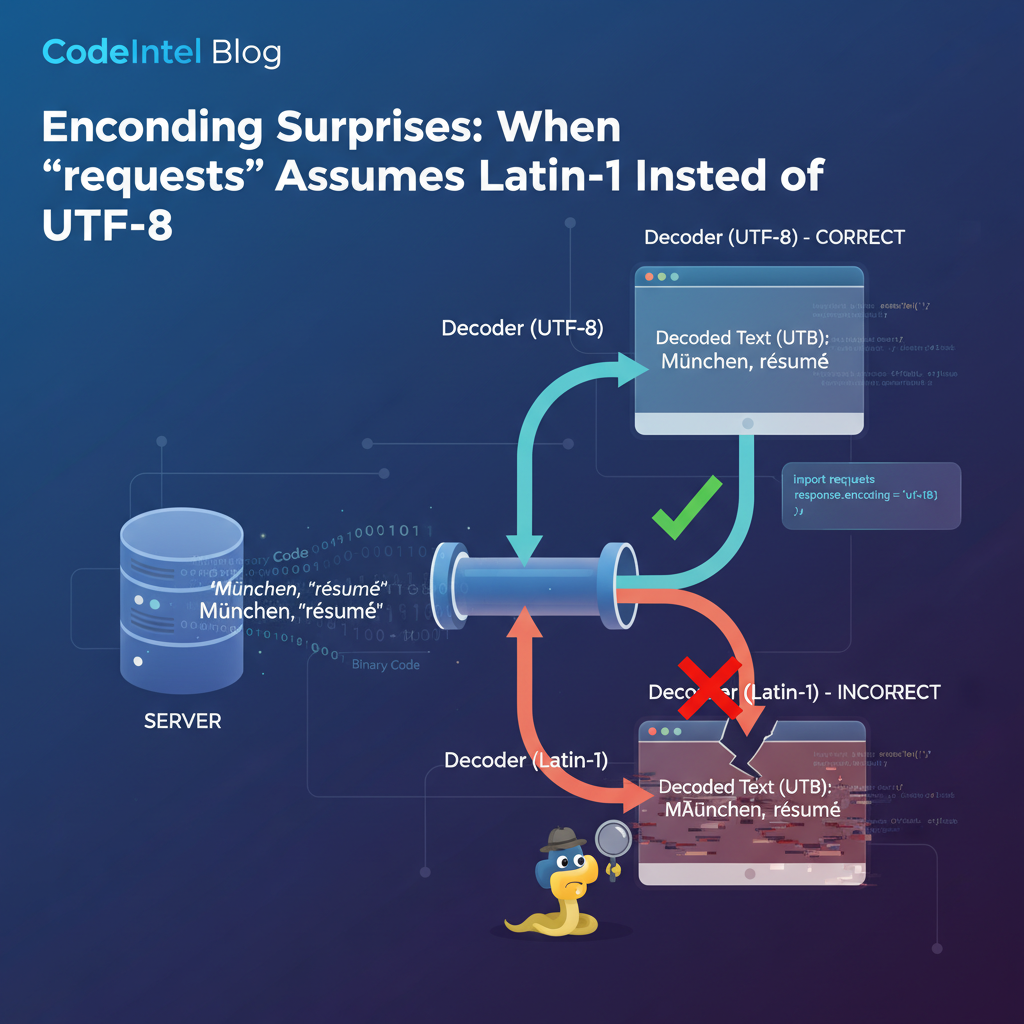
The bottom line: Hardcoded Latin-1 encoding in HTTP auth headers causes UnicodeEncodeError for non-Latin usernames.
The Problem
psf/requests issue #6102 exposes a subtle edge case in how python handles boundary conditions. The fix is only 2 lines, but the pattern behind it applies across projects.
PR: https://github.com/psf/requests/pull/7463
Status: Submitted (awaiting review)
Hardcoded character encodings are a ticking time bomb. When code assumes latin-1 for
string encoding, it works for English, German, and most Western European users — but breaks
for anyone with Chinese, Japanese, Korean, Arabic, or emoji in their input.
import base64

# Before: Latin-1 breaks non-Latin characters
def basic_auth_header(username, password):
    raw = f'{username}:{password}'.encode('latin-1')
    # UnicodeEncodeError if username contains non-Latin chars
    return 'Basic ' + base64.b64encode(raw).decode()

# After: UTF-8 handles the full Unicode range
def basic_auth_header(username, password):
    raw = f'{username}:{password}'.encode('utf-8')
    return 'Basic ' + base64.b64encode(raw).decode()
How to Apply This to Your Code
Audit Your Auth Code for Latin-1 Assumptions
-
grep for
encode('latin-1')—grep -rn "encode.*latin" src/**/*.py | grep -v test. Every hit is a potential UnicodeEncodeError for international users. Replace'latin-1'with'utf-8'. -
grep for
encode('iso-8859-1')— same issue, different alias. UTF-8 covers the full Unicode range. -
Check header construction code — not just auth. Any header that includes user-provided strings (User-Agent, X-Forwarded-For, custom headers) with hardcoded encoding can silently break.
-
Add a test with non-Latin input —
requests.get(url, auth=HTTPDigestAuth('ユーザー名', 'パスワード')). If this errors or produces garbled headers, you’ve found the bug.
Detection Checklist
| Pattern | Risk | Fix |
|---|---|---|
encode('latin-1') in auth |
UnicodeEncodeError for CJK, Arabic, emoji | encode('utf-8') |
encode('iso-8859-1') in headers |
Same encoding issue | encode('utf-8') |
b64encode(str.encode('latin-1')) |
Auth tokens are invalid for non-ASCII users | UTF-8 encode before base64 |
| No non-ASCII test coverage | Bug exists but undetected | Add pytest case with CJK credentials |
When to Check
- After any upgrade to
requests,urllib3, orhttpx— library changes can break encoding assumptions - When adding international user support to any system with HTTP auth
- During code review of any PR that touches
auth.pyor header construction - Any time you see
encode('latin-1')in a codebase — it’s almost always wrong for modern applications
Key Takeaway
Never hardcode Latin-1 for user-provided strings. Always use UTF-8 — it’s backward-compatible with ASCII and handles the full Unicode range. The error won’t appear in testing with English data. This fix swaps one encoding constant for another, but the downstream impact is global: every non-Latin user gets a working auth flow instead of a crash.
Discovered while fixing psf/requests#6102. View the fix post for the specific diff.
📖 Related Reads
- ToolBrain — tool reviews, LLM comparisons, and AI workflow guides
Cross-links automatically generated from CodeIntel Log.